Old World: The 4X Strategy Game That Cares More About People Than Borders
Type “old world game” into a search bar and you might expect a list of ancient civilizations or a history lesson. Instead, you’ll land on something more specific: Old World, a 2021 historical strategy game from Mohawk Games that asks a simple but rarely explored question — what if a 4X game cared as much about your ruler’s marriage as your empire’s borders?
If you’ve played Sid Meier’s Civilization and wondered why your leader never seems to age, get sick, or make a bad political decision out of pure spite, this is the game built for that itch.
Quick Summary Box
- Genre: Historical 4X strategy with dynasty simulation
- Developer: Mohawk Games (founded by Soren Johnson, lead designer of Civilization IV)
- Setting: Ancient and classical antiquity — Rome, Egypt, Persia, Greece, and more
- Platforms: Windows, macOS, Linux (Steam, GOG, Epic Games Store)
- Multiplayer: Yes, plus solo play and weekly challenge scenarios
- Best for: Players who want strategy with story, not just spreadsheets
What Makes Old World Different From Every Other 4X Game
Most 4X games treat your civilization as a machine. You build things, the machine grows, you win. Old World incorporates dynasty simulation and narrative elements reminiscent of the Crusader Kings series, where nations’ leaders age and die and an heir must be ready to step up. That single design decision changes everything about how the game feels to play.
A few mechanics stand out:
The Orders system replaces the “one move per unit” rule. Instead of moving every unit once per turn, each unit can be moved multiple times until fatigued or Orders are depleted, and Orders are a resource shared across the whole realm. In practice, this means a strong, legitimate ruler can act far more decisively in a single turn than a weak one — legitimacy isn’t just flavor text, it’s tactical currency.
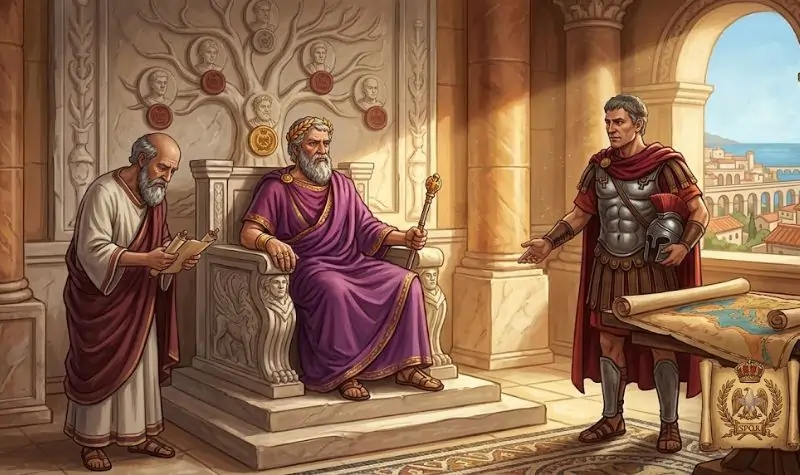
Your leader is mortal, and that matters. Every turn represents a year, and as the empire advances, its leader grows old and dies, needing to produce an heir who will have their own ambitions. Marriages, family rivalries, and succession aren’t side menus — they can decide whether your empire holds together or fractures.
Technology isn’t a fixed tree. Randomization keeps the tech tree feeling different with each playthrough, which stops veteran players from just memorizing an optimal build order and running it every game.
The “barbarians” have names and grievances. Rather than being faceless raiders, non-nation peoples like the Gauls or Numidians can be negotiated with, allied with, or fought — closer to how ancient diplomacy actually worked than the usual 4X shorthand.
Old World vs Civilization: How They Actually Differ
Comparisons to Civilization are inevitable, given that lead designer Soren Johnson previously worked on Civilization III and IV. But the games solve different problems.
| Aspect | Old World | Civilization Series |
|---|---|---|
| Time scale | Ancient/classical era only, deep focus | Stone Age to Space Age, broad sweep |
| Core tension | Family, succession, legitimacy | Tech race, territory, victory conditions |
| Turn pacing | Orders-based, flexible unit actions | One action per unit per turn |
| Story generation | Dynamic, character-driven events | Mostly systemic, less personal |
| Learning curve | Steeper — more interlocking systems | Gentler, more forgiving for newcomers |
| Match length | Typically shorter, more focused | Can run very long, especially large maps |
Neither approach is objectively better — it depends on what you want from a session. Civilization rewards long-term empire building across millennia. Old World rewards paying attention to individual characters over a tighter historical window.
The Nations and DLC: What You’re Actually Buying
The base game ships with seven playable nations — Assyria, Babylonia, Carthage, Egypt, Greece, Persia, and Rome — with three more added through DLC: the Hittites, Kush, and Aksum. As of early 2026, several expansions have released, each adding nations, mechanics, or scenario content rather than reskinning the same systems.
| DLC | What It Adds |
|---|---|
| Heroes of the Aegean | Hittites as a playable nation, Greek-themed scenarios |
| Pharaohs of the Nile | Kush as a playable nation, Bronze Age Collapse content |
| Wonders and Dynasties | Largest content pack, adds significant replay variety |
| The Sacred and The Profane | Religion and dissent-focused event mechanics |
| Behind the Throne | Court politics, rivalries, and the Grand Vizier role |
| Wrath of Gods | Aksum as a playable nation, divine-themed content |
A recurring point from long-time players is that the base game is a complete experience on its own — the DLC diversifies replayability rather than fixing gaps. If you’re new to the game, starting with the base version before deciding which expansions match your playstyle is a reasonable approach.
Who Will Enjoy Old World — and Who Might Not
You’ll likely enjoy it if:
- You want a strategy game where individual characters have real consequences
- You like Crusader Kings-style drama but find its scope overwhelming
- You prefer shorter, focused matches over 8-hour Civilization marathons
- You appreciate systems that reward legitimacy and diplomacy, not just military power
It might not be for you if:
- You want a simple, breezy strategy game to relax with
- You dislike managing family relationships, marriages, and succession on top of city management
- You’re looking for a huge time span from ancient history through the modern era
- You want a low learning curve — Old World asks you to juggle several interlocking systems at once
System Requirements and Compatibility
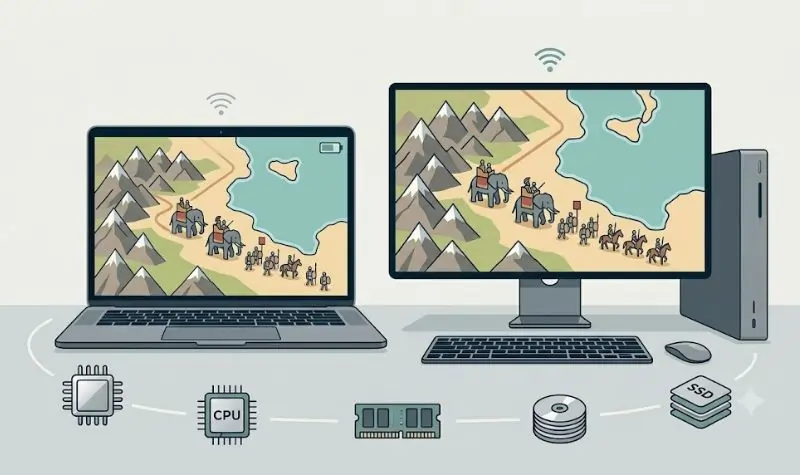
To play Old World you’ll need a minimum CPU equivalent to an Intel Core i5-4570, with the developers recommending an Intel Core i5-8600K or better for smoother performance. The game asks for at least 8 GB of RAM, though 16 GB is recommended, and roughly 10 GB of free disk space. A 64-bit operating system and Vulkan-compatible graphics drivers are required to run the game.
The game runs natively on Windows, macOS, and Linux, so compatibility issues are rare on modern hardware. If you’re running an older laptop, the minimum specs are modest enough that Old World isn’t especially demanding by current standards — this isn’t a game that needs a high-end GPU to look and run well.
Editor’s Insight
Most coverage of Old World focuses on the Orders system or the Civilization comparison, and both are worth knowing about. What gets less attention is how the mortality mechanic changes your relationship to risk. In a game where your leader will die anyway, reckless wars and bold gambles start to feel less like mistakes and more like the point — your legacy isn’t one perfect empire, it’s a messy family history full of good rulers and embarrassing ones. That’s a genuinely different emotional experience than most strategy games offer, and it’s arguably the real reason critics kept comparing it to Crusader Kings rather than just filing it alongside other 4X titles.
Frequently Asked Questions
Is Old World a sequel or spin-off of Civilization?
No. It’s an entirely separate game and IP, developed by Mohawk Games. The connection is that lead designer Soren Johnson previously worked on Civilization III and IV, which shaped some of the design philosophy but not the setting or mechanics directly.
Does Old World have multiplayer?
Yes, alongside single-player campaigns, historical scenarios, and weekly challenge games with generated seeds that all players can compare scores on.
Do I need the DLC to enjoy the game?
No. Reviewers and long-time players consistently describe the base game as a complete, well-balanced experience. The expansions add nations and mechanics for players who want more variety after finishing the core game.
Is Old World hard to learn?
It has a steeper learning curve than more streamlined 4X games, mainly because of how many systems interact — Orders, legitimacy, family events, and diplomacy all affect each other. Players who enjoy Crusader Kings-style complexity tend to adapt quickly.
What time period does Old World cover?
It’s set specifically in ancient and classical antiquity, following nations like Rome, Egypt, Persia, and Carthage, rather than spanning all of human history like Civilization does.
Final Verdict
Old World isn’t trying to be a bigger or better Civilization — it’s solving a different problem entirely, and that’s exactly why it’s carved out its own audience since launch. If the idea of managing a dynasty rather than just an empire sounds more interesting than another tech-race strategy game, this is likely to become one of the more replayed titles in your library.